
A New Way of Understanding Organizations
You can’t fix what you can’t see.
Every decision your organization makes depends on one assumption: that you understand what’s really happening. What if you don’t?
the reality
Most organizations don’t struggle because they lack information. They struggle because they misunderstand what they’re seeing.
Organizations generate an endless stream of information. Dashboards, surveys, meetings, reports, KPIs, performance reviews, customer feedback. Yet despite having more data than ever before, many leaders still find themselves asking the same questions.
Why isn’t this getting better?
What are we missing?
Why does this keep happening?
The issue is rarely a lack of information. It’s that organizations often mistake explanations for evidence, intentions for reality, and assumptions for understanding. As a result, they invest time and money solving the wrong problem while the real one quietly continues to shape decisions, behaviour, and performance.
A DIFFERENT WAY OF LOOKING
The answers you’re looking for may already be in front of you.
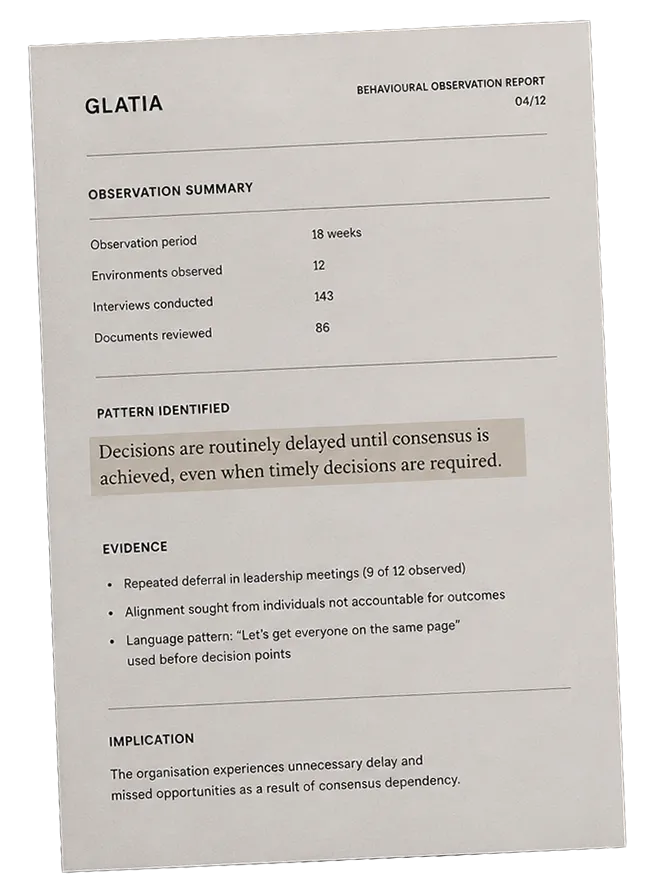
When leaders want to understand what’s happening inside their organization, they do what most of us would do. They ask people. They gather feedback. They review reports, hold meetings, and look for answers in the explanations they’re given.
There’s nothing wrong with that.
The problem is that explanations are shaped by memory, assumptions, politics, personal experience, and the natural desire to make sense of complex situations. Even honest people can only describe the organization as they understand it.
Behaviour doesn’t have that problem.
Behaviour leaves evidence.
The behaviours no one questions are often the ones shaping the organization.
the evidence
Nine organizations. One recurring pattern.
Every organization arrived with a different challenge. Different industries. Different leadership teams. Different questions.
Some wanted to understand declining performance. Others were concerned about compliance, operational risk, customer experience, inconsistent decision-making, or behaviours that simply didn’t make sense.
Yet across every engagement, one pattern emerged again and again.
Leadership believed one thing was happening. Observable behaviour consistently revealed something else.
These case studies aren’t success stories. They’re evidence. Each one documents a real investigation into the gap between what an organization believed to be true and what its behaviour ultimately revealed.

When organizations adapt to contradiction.
Employees weren’t resisting change. They were responding rationally to two competing versions of the organization’s identity.
technology

When incentives quietly redefine compliance.
A wealth management firm’s documentation practices reflected its incentive structure more accurately than its written policies.
financial services

When everyone trusts a number no one has verified.
A retailer’s board relied on a performance metric that had never measured what everyone believed it measured.
professional services

When routine quietly becomes organizational risk.
A software company’s security exposure wasn’t caused by bad intentions. It emerged through everyday behaviours that had become accepted as normal.
healthcare
When behaviour exposes what reports never could.
A pattern that appeared isolated at first proved to be a systemic issue once behaviour was examined across the organization.
Education

When private rulebooks replace shared standards.
Different employees developed different ways of doing the same work, creating operational inconsistency that no policy had ever addressed.
Manufacturing

When the evidence refuses a conclusion.
An investigation uncovered potential legal and regulatory exposure, but stopped where the evidence could no longer support a defensible conclusion.
Retail
A DIFFERENT QUESTION
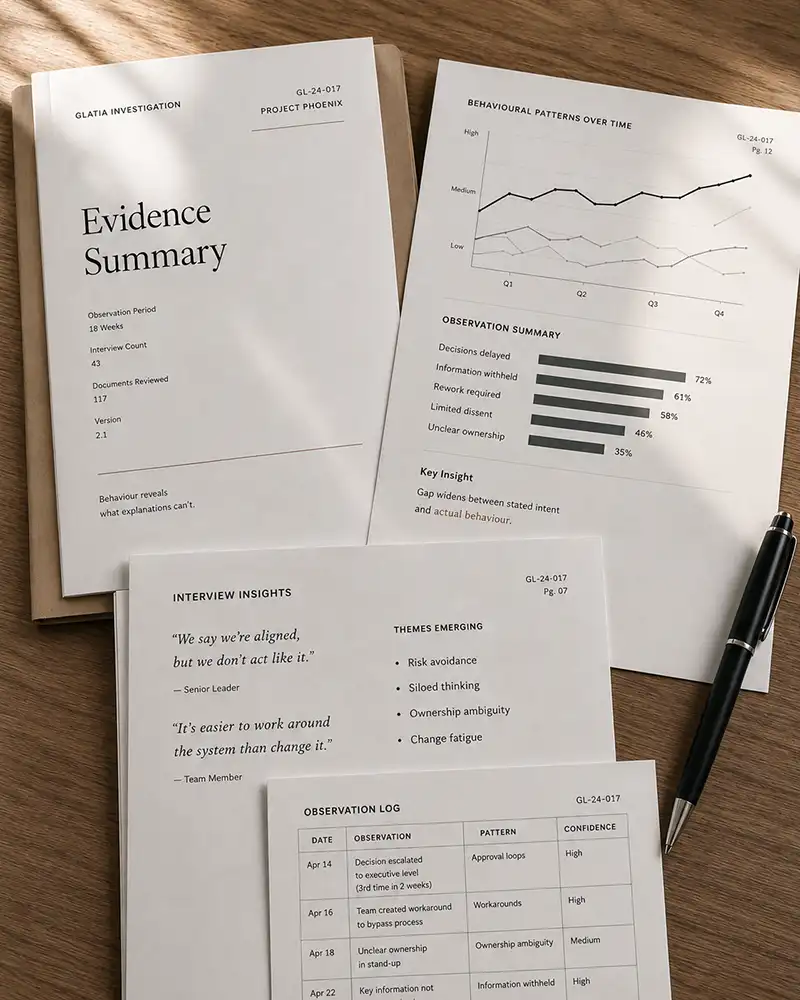
The evidence was never in what people say. It’s in what they repeatedly do.
Most organizational investigations begin by asking people what they think is happening. Leaders are interviewed. Employees are surveyed. Teams are asked to explain why a problem exists and what they think should change.
Those conversations matter, but they aren’t where I begin. I start with a different question.
What is this behaviour trying to tell us?
It’s a simple question, but it changes everything.
Instead of treating behaviour as the problem, it treats behaviour as evidence. Every recurring pattern, workaround, delay, disagreement, or unexpected success becomes a clue. The goal isn’t to confirm assumptions. It’s to understand what the organization is consistently revealing about itself through its actions.
Only then do the explanations begin to matter.
Years of Observation
Listening, learning, and paying attention to how organizations really work.
Cross-Industry Investigations
From healthcare to manufacturing, finance to technology, public sector to non-profit.
Of Behavioural Observations
Interviews, documents, decisions, and day-to-day behaviour, patterns that speak for themselves.
Recurring Question
Why is there always a gap between what organizations believe and what they actually do?
the person behind the work
Thirty years of observation changed the questions I asked.
Thirty years of observation changed the questions I ask.
For more than three decades, I’ve worked with organizations across industries as a Creative Director, strategist, and executive leader.
Over time, I noticed the same pattern repeating. Organizations rarely struggled because they lacked intelligent people or good intentions. They struggled because they were acting on an incomplete understanding of what was actually happening.
That realization changed the way I approached every engagement. Instead of beginning with explanations, I began with observation. Instead of asking people what they believed was happening, I started looking at what the organization consistently did.
Everything published through GLATIA grows from that shift in perspective.

WHY GLATIA EXISTS
Some problems can’t be solved until they’re understood more accurately.
Organizations already invest in strategy, leadership development, compliance, employee engagement, and performance improvement. Each serves an important purpose.
GLATIA exists because there is surprisingly little work devoted to a more fundamental question:
How do organizations know their understanding is accurate in the first place?
It is an evolving body of work dedicated to understanding organizations through observable behaviour rather than assumption, helping leaders think more critically about the gap between what an organization believes is happening and what its behaviour consistently reveals.
Everything published through GLATIA exists to explore that question.
CONTINUING THE CONVERSATION
Organizations are always teaching us something. If we’re paying attention.
GLATIA is an evolving body of work. Every investigation, article, and manuscript explores a different aspect of organizational understanding, challenging assumptions, examining behaviour, and asking better questions about how organizations actually operate.
Because no single investigation tells the whole story.
The work continues.
If something you’ve read here has challenged the way you think about organizations, I’d be interested in hearing your perspective.
I’m always interested in thoughtful conversations with leaders, researchers, executives, and people who care deeply about how organizations really work.